



All auctions / Ancient Art / Statue, Lord Khandoba en zijn gemalin Mhalsa te paard - 17.6 cm - Bronze

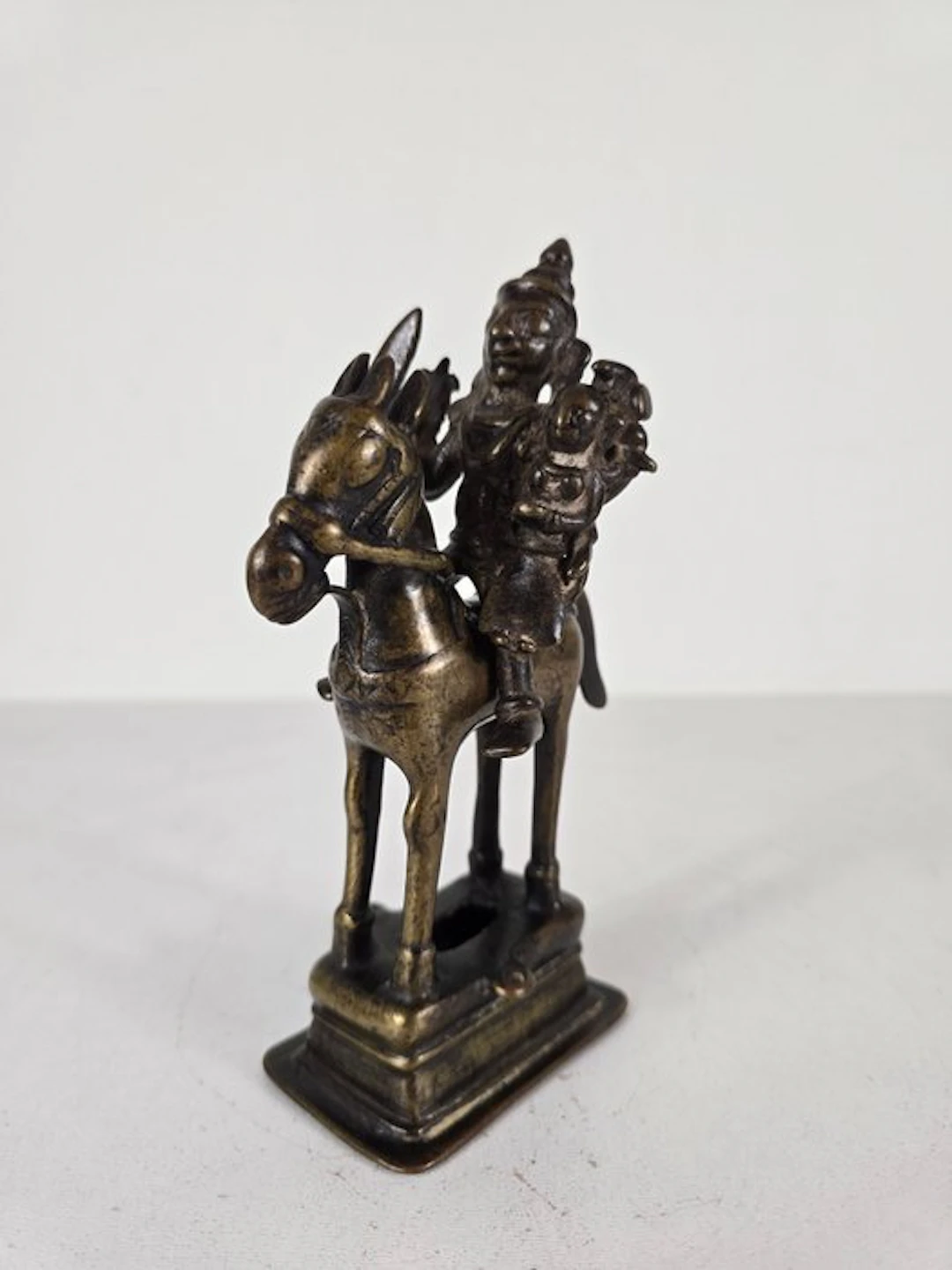
Extremely rare and museum-worthy example of an antique, two-piece Hindustani temple sculpture from West India, dating from the early to mid-nineteenth century. This type of religious folk art, in the international art trade known as an Indian Folk Bronze, presents a classical and iconographically complete portrayal of Lord Khandoba and his consort Mhalsa on horseback. Lord Khandoba is a fierce, protective manifestation or avatar of the Hindu god Shiva, revered in the Deccan region. His wife Mhalsa is regarded as a direct incarnation of the goddess Parvati. The rider is characteristically modeled with large, expressive almond-shaped eyes and a broad smile. In his right hand he raises his primary attribute, the ceremonial curve-blade or dagger with which, according to mythology, he defeated the demons Mani and Malla. In his left hand, subtly positioned behind the horse’s ears, he holds a secondary ritual attribute, presumably a stylized scepter or damaru drum. Mhalsa sits in a traditional amazone seat on his left side, her silhouette beautifully softened by decades of devotion and ritual contact. The rider wears a cone-shaped, layered headdress that is specifically attributed to the historical Maratha dress. What makes this specific sculpture technically and connoisseurially exceptionally valuable is the ingenious modular construction. Unlike many later reproductions, this object was produced in two separate parts in full accordance with the early-nineteenth-century casting tradition. On the horse’s back lies a solid, rectangular pin that closes seamlessly into an integrated bronze ring construction under the rider’s saddle. This construction offered the priests, during daily puja, the flexibility to remove the deity from his steed for individual anointings, holy oil cleansings, or presentation on a separate altar platform. The fact that both original parts have remained inseparably together for more than a century and a half and the mechanical closure functions perfectly is an absolute rarity in the Asian art market. The horse itself is powerfully and proudly stylized with geometrically incised tack, almond-shaped eyes, and a long, flowing tail. At the rear there is also an original cast stand that served to stabilize the top-heavy model during the manufacturing process. The figurine was crafted using the complex lost-wax method, whereby the mold had to be broken open after the casting, making each specimen a unique unique piece. The metal structure consists of a heavy, solid-cast copper alloy with a high zinc and tin content, giving the object its characteristic yellow-gold brass sheen on parts exposed by wear. The object stands 17.6 centimeters high, 10.2 centimeters wide, 6 centimeters deep, and weighs a substantial 530 grams. The whole is anchored on a layered rectangular pedestal with a central opening at the top, originally intended to remove the core of sintered clay after firing. At the sides of this pedestal lie two integrated processile lugs showing light historical wear from pins or cords, with which the statue was bound to a larger processional wagon during temple festivals. The sculpture is in impeccable condition and fully authentic, with no form of later restorations, cracks, or modern machining. There is subline, layered aging patina, with the deeper grooves and the interior of the pedestal developing a dense, dark oxidized layer, while the protruding parts are softly polished to a glossy finish from generations of devotional use. The underside of the pedestal also houses an invaluable provenance detail in the form of an old, historical paper collector’s label hand-inscribed with "Shiva + Parvati, Maharashtra." This label confirms not only the exact geographic origin in the western Indian state of Maharashtra but also proves that the object has long formed part of an old, carefully cataloged Western private collection. This museum centerpiece represents superior documentation of Indian tribal bronze casting art and is a splendid addition for the connoisseur of Asian art and Hindustani antiquities. Dimensions: 17.6 x 10.2 x 6 cm Weight: 530 g
Estimate:$224.74
To the auctionView all items fromCatawikiorAncient Art
Estimate:
$224.74




OCT 17 | 10:00 PM
Bring your auction to collectors worldwide!
Get listed nowBy subscribing, you are agreeing to the privacy policy. Unsubscribe anytime.
Barnebys HQ
Brahegatan 10
BOX 5038
114 37 Stockholm
